
News & Events

How Should You Choose a Packaging Container Supplier Under the P.I.F. System?
June 25,2026
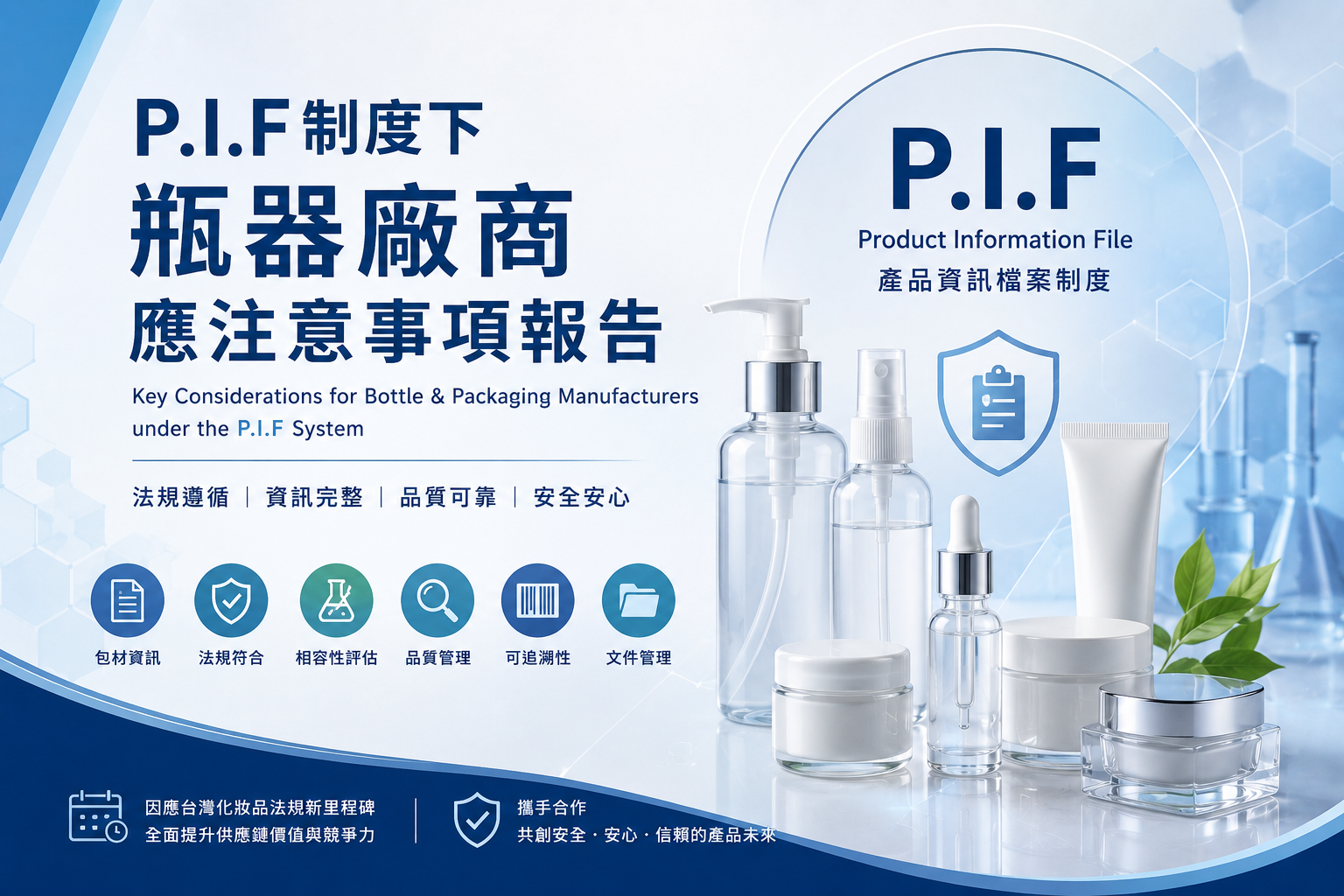
How Packaging Container Suppliers Should Prepare for the Product Information File (P.I.F.) System
1. Introduction
With the implementation of the Product Information File (P.I.F.) requirements under Taiwan's Cosmetic Hygiene and Safety Act, all general cosmetics (except handmade soaps) are now subject to the P.I.F. system.
Although the legal responsibility for establishing and maintaining a P.I.F. rests with the Responsible Person (brand owner, manufacturer, or importer), packaging container and packaging material suppliers play a critical role as key providers of product information. The completeness and accuracy of the documentation they provide directly affect whether cosmetic companies can successfully compile their P.I.F.
Therefore, packaging suppliers should strengthen their regulatory awareness and establish comprehensive packaging documentation management systems to meet industry expectations and enhance their competitiveness.
2. The Role of Packaging Suppliers in the P.I.F. System
Although packaging suppliers are not legally responsible for creating the P.I.F., they are essential partners within the cosmetic supply chain. Their primary responsibilities include providing:
-
Packaging material specifications
-
Quality specification documents
-
Packaging safety documentation
-
Compatibility information
-
Quality management records
-
Traceability information
These documents are commonly incorporated into the cosmetic company's Product Information File for inspection by the competent authorities.
3. Six Key Considerations for Packaging Suppliers
(1) Establish Complete Material Information
Suppliers should provide comprehensive information for every packaging component, including:
-
Bottle material (PET, PETG, PP, PE, HDPE, Glass, etc.)
-
Cap material
-
Pump material
-
Dropper material
-
Tube material
-
Gasket or liner material
-
Color masterbatch information
-
Percentage of PCR (Post-Consumer Recycled) plastic used, where applicable
Complete material information enables cosmetic companies to perform proper product safety assessments.
(2) Provide Complete Regulatory Compliance Documents
The following technical documents are highly recommended:
-
Material Specification
-
Technical Data Sheet (TDS)
-
Declaration of Compliance (DoC)
-
Material Certificate
-
Certificate of Analysis (COA)
-
Safety Data Sheet (SDS), where applicable
For products intended for international markets, suppliers should also be able to provide:
-
REACH Declaration
-
RoHS Declaration
-
SVHC Declaration
-
BPA-Free Declaration
-
Phthalate-Free Declaration
(3) Emphasize Packaging Compatibility Testing
Different cosmetic formulations may interact differently with packaging materials. Suppliers are encouraged to establish compatibility testing capabilities, including situations such as:
-
Alcohol-based products causing PET cracking
-
Essential oils leading to leakage
-
Sunscreen formulations causing discoloration
-
Acid-containing products corroding spray pumps
-
High-viscosity products affecting pump performance
Providing Packaging Compatibility Test Reports can significantly increase customer confidence.
(4) Establish a Complete Traceability System
Suppliers should maintain traceability records that include:
-
Raw material batch numbers
-
Production batch numbers
-
Mold cavity numbers
-
Manufacturing dates
-
Shipment batch numbers
When cosmetic companies undergo regulatory inspections, complete traceability enables rapid identification of packaging sources and improves supply chain management.
(5) Implement a Robust Quality Management System
A comprehensive quality management process is recommended, including:
Incoming Quality Control (IQC)
-
Incoming material inspection
-
Raw material verification
-
Material identification
In-Process Quality Control (IPQC)
-
Dimensional inspection
-
Visual inspection
-
Weight verification
Outgoing Quality Control (OQC)
-
Seal integrity testing
-
Leakage testing
-
Torque testing
-
Drop testing
-
Final appearance inspection
These quality records may also serve as supporting documentation within the P.I.F.
(6) Develop a Standardized Documentation Package
Suppliers are encouraged to prepare a standardized Packaging Compliance Package for each packaging item.
The package may include:
-
Packaging drawings
-
Material Specification
-
Technical Data Sheet (TDS)
-
Certificate of Analysis (COA)
-
Safety Data Sheet (SDS)
-
Material Certificate
-
Declaration of Compliance (DoC)
-
BPA-Free Declaration
-
REACH Declaration
-
SVHC Declaration
-
Heavy Metal Compliance Declaration
-
Packaging compatibility recommendations
-
Quality inspection reports
A standardized documentation package improves response efficiency and significantly shortens the time required for customers to establish their P.I.F.
4. Future Expectations from Cosmetic Brands
As the P.I.F. system becomes fully established, cosmetic brands are likely to require more comprehensive documentation from packaging suppliers, including:
-
Packaging compatibility test reports
-
Raw material traceability records
-
Product Change Notifications (PCN)
-
Annual regulatory compliance declarations
-
ISO 9001 certification
-
GMP-related supporting documents
-
Packaging risk assessment reports
Packaging suppliers should proactively establish these systems to strengthen their market competitiveness.
5. Recommended P.I.F. Packaging Documentation Package
Each packaging item should have its own dedicated documentation folder containing at least the following:
| Document | Recommended |
|---|---|
| Packaging Drawing | ✓ |
| Material Certificate | ✓ |
| Material Specification | ✓ |
| Technical Data Sheet (TDS) | ✓ |
| Certificate of Analysis (COA) | ✓ |
| Safety Data Sheet (SDS) (if applicable) | ✓ |
| Declaration of Compliance (DoC) | ✓ |
| BPA-Free Declaration | ✓ |
| REACH / SVHC Declaration | ✓ |
| Heavy Metal Compliance Declaration | ✓ |
| Compatibility Test Report | ✓ |
| Quality Inspection Records | ✓ |
| Batch Traceability Records | ✓ |
6. Recommended Strategies for Packaging Suppliers
Packaging suppliers are encouraged to focus on the following five areas:
-
Establish a comprehensive packaging technical documentation database.
-
Develop a systematic regulatory compliance document management system.
-
Implement batch traceability and quality management systems.
-
Provide packaging compatibility testing and technical support.
-
Regularly update regulatory information to support customers' P.I.F. requirements.
7. Conclusion
Although cosmetic companies are legally responsible for establishing the Product Information File (P.I.F.), packaging suppliers have become indispensable partners throughout the supply chain. In the future, customers will place even greater emphasis on the completeness, regulatory compliance, and traceability of packaging information.
By establishing a comprehensive packaging documentation management system and providing standardized P.I.F. Packaging Compliance Packages, packaging suppliers can not only help customers efficiently meet regulatory requirements but also strengthen their professional image, build greater customer trust, create new business opportunities, and position themselves as high-value, competitive partners within the cosmetics industry.