
Blog

- Home
- Blog
- Beauty and Health
- Taiwan's PIF Regulations Are Coming—Are You Ready?
Taiwan's PIF Regulations Are Coming—Are You Ready?
June 25,2026
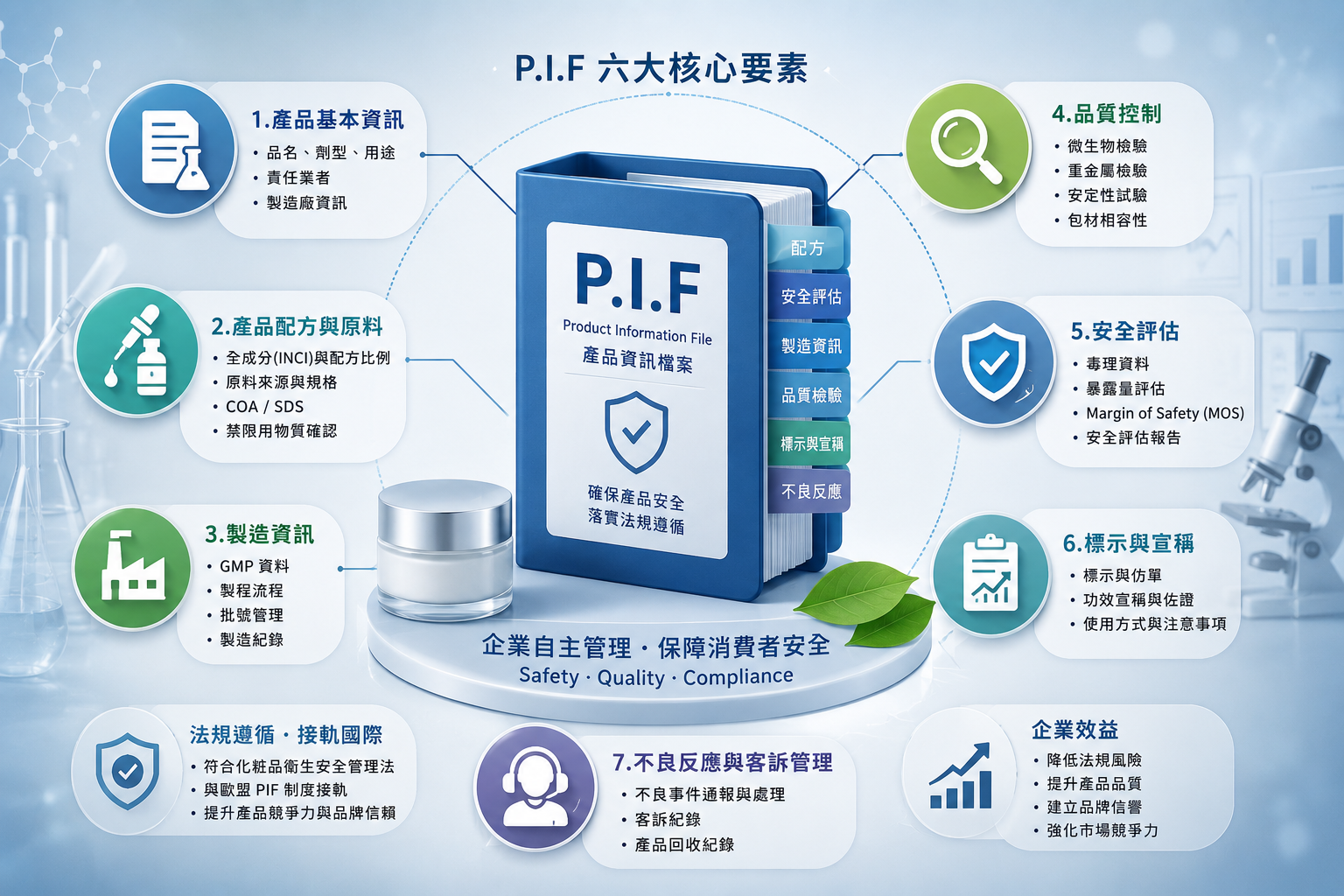
2. What is a Product Information File (PIF)?
PIF (Product Information File)
Chinese Name:
Cosmetic Product Information File
It can be regarded as:
The "product identity card" and comprehensive technical safety documentation for each cosmetic product.
The purposes of a PIF include:
- Establishing a complete product history and traceability
- Demonstrating product safety
- Supporting a product quality management system
- Providing documentation for regulatory inspections
- Strengthening brand accountability and compliance
- Aligning Taiwan's cosmetic regulatory system with the EU PIF framework
3. Regulatory Basis
The PIF system is primarily based on the following regulations and guidance documents:
- Cosmetic Hygiene and Safety Act
- Regulations Governing Cosmetic Product Information Files
- TFDA Guidance for Preparing Product Information Files (PIF)
- TFDA PIF Inspection Checklist
- Guidelines for Cosmetic Safety Assessment
4. PIF Implementation Timeline
| Phase | Effective Date | Applicable Products |
|---|---|---|
| Phase 1 | July 1, 2024 | Specific-purpose cosmetics such as sunscreens, hair dyes, hair perming products, antiperspirants, and tooth-whitening products |
| Phase 2 | July 1, 2025 | Lip products, eye products, baby cosmetics, non-medicated toothpaste, and mouthwash |
| Phase 3 | July 1, 2026 | All general cosmetics (except handmade soaps) |
5. Main Contents of a PIF
According to TFDA guidance, a Product Information File generally includes the following:
1. Basic Product Information
- Product name
- Dosage form
- Intended use
- Responsible company
- Manufacturer
2. Product Formula
- Full ingredient list (INCI)
- Formula composition
- Raw material sources
3. Raw Material Information
- Certificate of Analysis (COA)
- Safety Data Sheet (SDS)
- Raw material specifications
- Verification of compliance with prohibited and restricted substance requirements
4. Manufacturing Information
- GMP documentation
- Manufacturing process flow
- Batch management
- Manufacturing records
5. Quality Control
Including:
- Microbiological testing
- Heavy metal testing
- Stability testing
- Packaging compatibility testing
6. Safety Assessment
Including:
- Toxicological data
- Exposure assessment
- Margin of Safety (MOS)
- Cosmetic Safety Assessment Report
7. Product Efficacy Substantiation
Examples include:
- Moisturizing
- Whitening/Brightening
- Anti-wrinkle
- Sun protection
All efficacy claims should be supported by appropriate scientific studies or published literature.
8. Labeling Information
Including:
- Outer packaging
- Chinese labeling
- Package insert (if applicable)
- Directions for use
- Warnings and precautions
9. Adverse Reaction Information
Records should include:
- Customer complaint management
- Adverse event reports
- Product recall records
6. Cosmetic Safety Assessment System
The most significant change introduced by the PIF system is the transition from:
Government Pre-market Review
to
Industry Self-Management
Accordingly, cosmetic companies are responsible for preparing:
- Safety assessments
- Scientific supporting evidence
- Complete technical documentation
Regulatory authorities will primarily adopt a post-market inspection approach.
7. Key Points of Regulatory Inspection
The Taiwan Food and Drug Administration (TFDA) and local health authorities may inspect whether:
- A Product Information File has been established
- The PIF is complete and properly maintained
- The PIF can be readily provided upon request
- The safety assessment is scientifically justified
- Product claims are supported by adequate evidence
- Product labeling complies with applicable regulations
8. Challenges for Cosmetic Companies
Document Integration
Required documentation is often scattered among:
- OEM manufacturers
- ODM manufacturers
- Raw material suppliers
- Testing laboratories
Lack of Qualified Safety Assessors
Safety assessments require expertise in:
- Toxicology
- Chemistry
- Cosmetic regulations
Increased Testing Costs
Additional testing may include:
- Stability testing
- Microbiological testing
- Preservative efficacy testing
- Efficacy verification
Imported Cosmetic Brands
Importers may need to obtain from overseas manufacturers:
- Formula information
- Raw material documentation
- Safety data
This may increase the complexity and cost of international coordination.
9. Recommended Actions for Companies
Step 1
Conduct a product inventory
↓
Determine whether each product requires a PIF.
Step 2
Collect supporting documentation
Including:
- COA
- SDS
- Product formula
- Test reports
Step 3
Perform a gap analysis
Identify:
- Missing documents
- Additional data required
Step 4
Complete necessary testing
Examples include:
- Stability testing
- Microbiological testing
- Efficacy testing
Step 5
Complete the safety assessment
Finalize and maintain a complete Product Information File.
10. Risks of Non-Compliance
Failure to comply with PIF requirements may result in:
- Corrective actions within a specified period
- Product withdrawal from the market
- Administrative penalties
- Damage to brand reputation
- Suspension of product sales by distributors or retailers
The competent authorities will conduct inspections and impose enforcement actions in accordance with the Cosmetic Hygiene and Safety Act and related regulations.
11. Conclusion
The implementation of the Product Information File (PIF) system marks Taiwan's transition from a government pre-market review model to a regulatory framework emphasizing industry self-management with post-market regulatory oversight.
Beginning July 1, 2026, all general cosmetics (except handmade soaps) will be subject to mandatory PIF requirements. Cosmetic manufacturers and importers are encouraged to complete product inventories, establish comprehensive documentation, conduct safety assessments, and strengthen internal quality management systems as early as possible to ensure regulatory compliance, minimize legal risks, and enhance product quality and market competitiveness.